 North
How to Start a Family Budget: Your First Month Step by Step
To start a household budget you do not need to cut anything in the first month: agree on the rules, gather every income and fixed bill in one place, and record what you spend. By the end of the month you have real numbers, and next month’s plan is built from them. Here is the sequence week by week.
Before you start: agree on a model
Shared money is usually organised in one of three ways: everything pooled; a common pot for joint costs plus personal money for each partner; or everything separate with bills split. No model is right for everyone, but it has to be agreed out loud. In an experiment by Jenny Olson and co-authors (Journal of Consumer Research, 2023), 230 engaged or newly married couples were randomly assigned to merge their accounts, keep them separate, or decide for themselves. Over two years, couples with a joint account maintained their relationship quality, while it declined in the other two groups; among couples left to choose, 72% kept separate accounts throughout. It is one study of young couples, not a universal recipe, but it suggests that transparency about money goes together with peace at home.
The first month, week by week
Week 1. Take stock
Write down every take-home income, the balances on cards and in cash, debts, and fixed bills with their dates: rent or mortgage, utilities, phone, loans, childcare. Choose one place for records and one person responsible for keeping them going.
Weeks 2–3. Record only
Log every purchase by both partners without judging it. Eight to ten categories are enough. Once a week, spend fifteen minutes together: what was logged, which bills are coming.
Week 4. Review and plan
Add up spending by category, compare it with income and allocate next month: fixed bills first, then savings, then the rest. Leave each partner an amount of personal money that needs no explanation.
Worked example: a household on $5,500
Daniel and Alina bring home $3,300 and $2,200. A month of tracking showed the picture below, and this is what they decided.
| Item | Actual | Plan |
|---|---|---|
| Housing and utilities | $1,900 | $1,900 |
| Groceries | $850 | $780 |
| Transport and phone | $650 | $650 |
| Loan | $450 | $450 |
| Children | $500 | $500 |
| Eating out, delivery, fun | $750 | $420 |
| Personal money ($150 each) | — | $300 |
| Other and unrecorded | $400 | $100 |
| Savings | $0 | $400 |
| Total | $5,500 | $5,500 |
The savings did not come from heroic frugality: $330 came from delivery and eating out, $300 from “other” that stopped vanishing, and $70 from groceries. Of the $700 freed up, $400 went to savings and $300 became personal money.
What the data says about household money
In the OECD/INFE 2023 survey of adults in 39 countries and economies, only 38% reported having money left over at the end of the month, and 54% said they could meet a major expense equal to one month’s income without borrowing or asking family and friends. As for where the money goes, the U.S. Bureau of Labor Statistics reports that in 2025 housing took 33.9% of average household spending, transportation 16.5% and food 13.0%.
Common mistakes
- Starting with bans. You can only cut what you have measured.
- Budgeting alone. If one partner sees the numbers, the other experiences the plan as control.
- No personal money. Reporting every coffee kills the idea quickly.
- Forgetting irregular bills. Insurance, school costs, gifts: divide the yearly total by 12.
- Quitting after a slip. A plan gets adjusted, not cancelled.
How to keep a household budget in 1cent
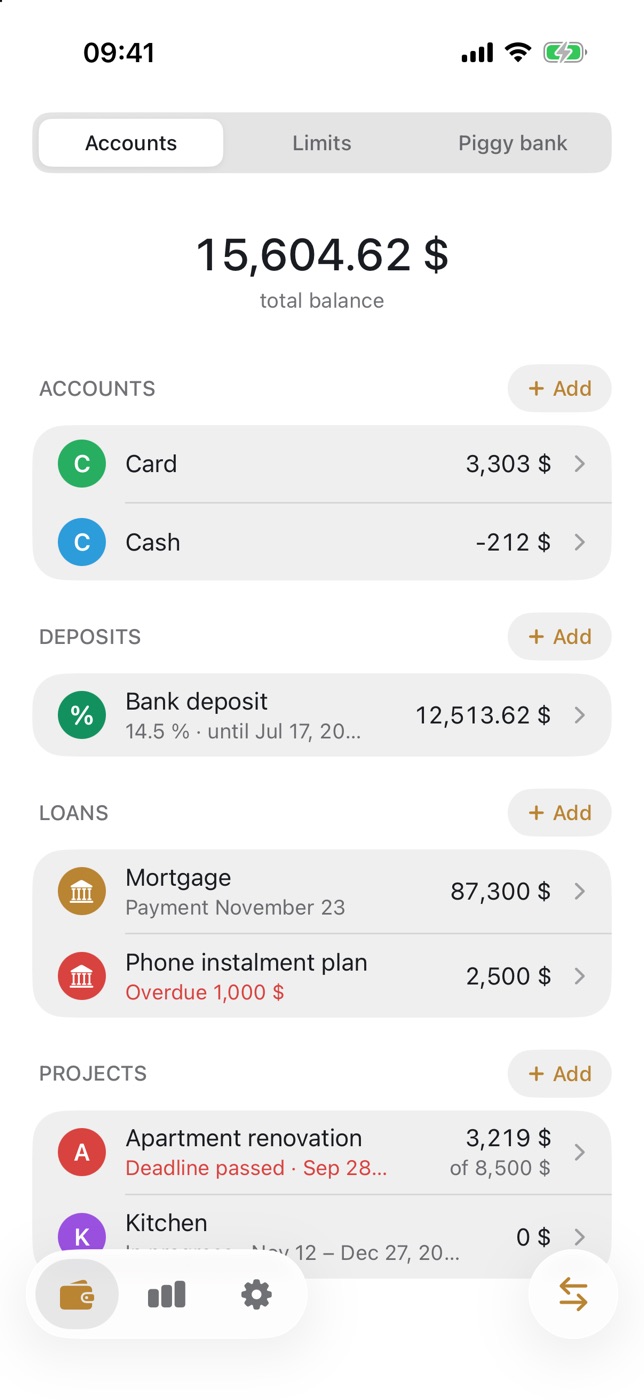
- Pick the phone that will hold the shared records and, on the first tab under “Accounts”, enter real balances: tap an account, tap the pencil button, fill in “Current balance” and tap “SAVE”.
- Log each purchase with the round arrows button: amount, account, checkmark, category. The “Note” field is handy for marking whose purchase it was.
- Record salaries as “Income” and moves between your own accounts as “Transfer”, so they do not count as spending.
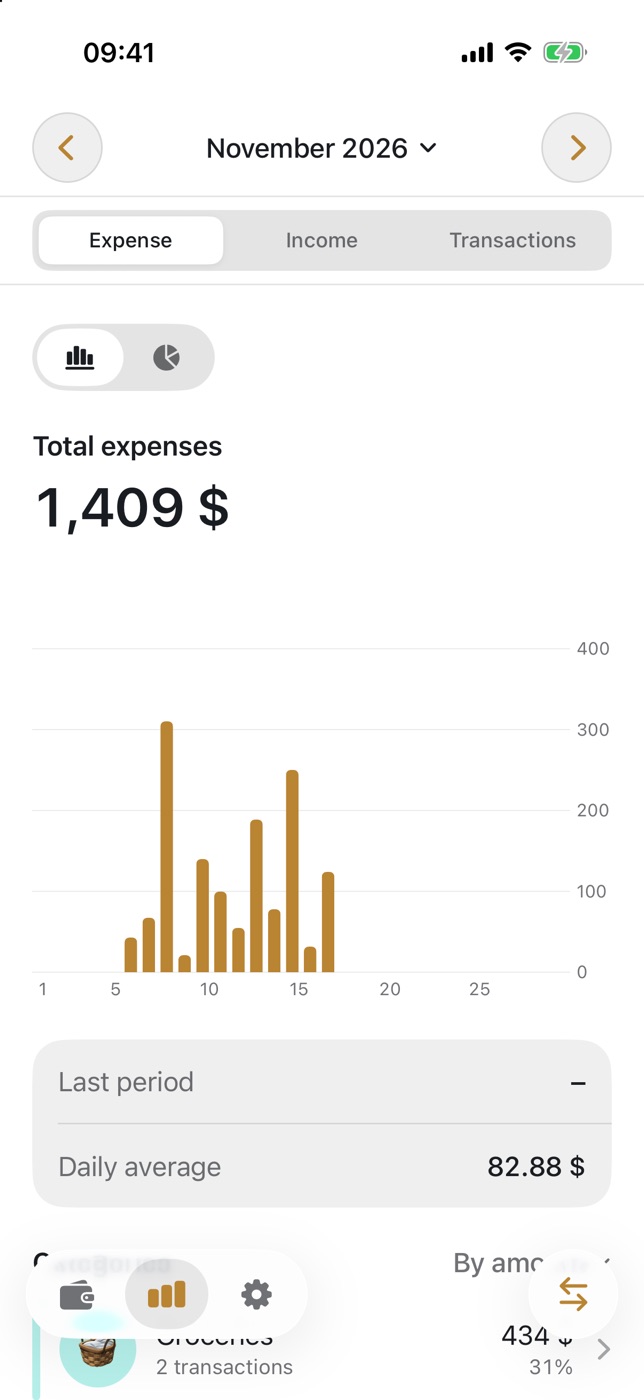
- Once a week open Analytics, “Expense”, and go through the categories together.
- From month two, set a limit on your main problem category under “Limits”.
The free version includes two accounts (for example “Card” and “Cash”), one limit and monthly analytics; more accounts and a limit for every category require the Premium subscription.
FAQ
Who should keep the budget?
Whoever finds recording easier can do it, but decisions about the plan are made together and both partners can see the numbers.
How do we split costs when incomes differ?
Equally, or in proportion to income. In the example above the shares are 60% and 40%: on $4,000 of joint costs that is $2,400 and $1,600. The fair option is the one both partners agree to.
How much time does it take?
A minute to log a purchase and about fifteen minutes a week for the joint review.
This article is general education, not individual financial advice.
Sources
- OECD/INFE 2023 International Survey of Adult Financial Literacy
- U.S. Bureau of Labor Statistics: Consumer Expenditures 2025
- Kellogg Insight on Olson et al., Journal of Consumer Research, 2023
- Olson J. et al. Common Cents: Bank Account Structure and Couples’ Relationship Dynamics. Journal of Consumer Research, 2023