 North
Emergency Fund: How Much You Need and How to Build It
An emergency fund is money set aside for the unexpected: a lost income, a medical bill, an urgent repair. A common yardstick is three to six months of essential expenses, but it makes sense to build it in stages: one month first, then three. If your household needs $2,500 a month for the basics, three months is $7,500 and six months is $15,000.
Why it matters, and how many people have one
Without a reserve, any shock turns into debt: a credit card balance, a loan, a favour from relatives. The U.S. Consumer Financial Protection Bureau (CFPB) points out that even a small amount provides some security, and that the right size depends on your situation.
Many households have little to fall back on. In the Federal Reserve’s Survey of Household Economics and Decisionmaking for 2024, 63% of U.S. adults said they would cover a $400 emergency expense with cash or its equivalent, 13% said they could not pay it by any means, and 55% had set aside savings for three months of expenses. In the OECD/INFE 2023 survey across 39 countries and economies, only 43% of adults said they could cover living expenses for at least three months if they lost their main income (49% across participating OECD countries).
How much you need
Base the number on essential spending rather than on salary: housing, food, transport, phone, medicine, required loan payments. FINRA, the U.S. financial industry’s self-regulatory body, notes that financial planners often recommend three to six months of living expenses, and that people with variable income may need more.
| Situation | Guideline | At $2,500 a month |
|---|---|---|
| First milestone for anyone | 1 month | $2,500 |
| Stable salary, two incomes | 3 months | $7,500 |
| Single earner, freelance, own business | 6 months | $15,000 |
Building it: a worked example
Sam’s household spends $2,500 on essentials and can put away $300 a month. The first milestone of $2,500 takes 9 months (8 × $300 is $2,400, so the ninth deposit crosses the line); three months of expenses, $7,500, takes 25 months. Adding a $900 tax refund or bonus at the end of the first year brings that down to 22 months. The CFPB’s techniques are simple: save consistently and, where possible, automatically on payday; send one-off money such as refunds or gifts to the fund; and track your progress.
Where to keep it
Three tests: safe, reachable on any day, and not so handy that it leaks into everyday spending. The CFPB lists a bank or credit union account, ideally a dedicated one, and cash, which can however be lost or stolen. FINRA suggests a liquid, interest-bearing account you can withdraw from without penalty. Interest is a bonus here, not the goal.
Most countries protect bank deposits up to a limit through a deposit insurance scheme, and the limit differs by country and sometimes by type of account. Check the figure on your national scheme’s official site before parking a large sum in one bank. Kazakhstan’s deposit guarantee fund, for example, lists different maximums for savings deposits in tenge, other tenge deposits and foreign-currency deposits.
Common mistakes
- Waiting for “spare” money. A small amount every month beats a large amount someday.
- Keeping the reserve on your main card. It dissolves into daily spending.
- Investing it in something risky. Its job is to be there on a bad day, not to earn.
- Not refilling it. After you use it, go back to regular deposits.
How to track an emergency fund in 1cent
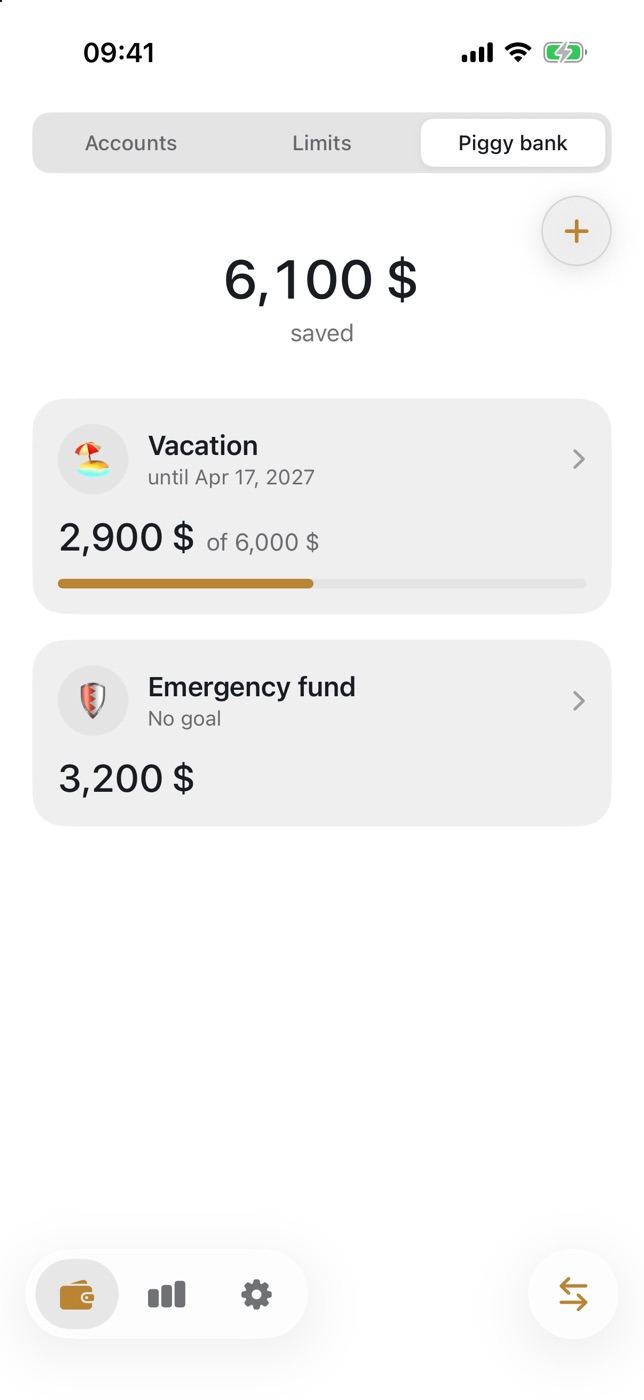
- On the first tab choose “Piggy bank” and tap “ADD PIGGY BANK”.
- In the “New piggy bank” form enter a name, for example “Emergency fund”, and put your first milestone in the “Goal” field. You can leave it empty to get a piggy bank with no goal.
- Optionally turn on “Save by date”: the app then shows the amount “Needed per month”.
- On payday tap the piggy bank, then “TOP UP”, and keep “Debit from account” switched on so the account balance goes down.
- If the reserve sits in a bank deposit, add it in the “DEPOSITS” block with its rate and term.
One piggy bank and one deposit are free; a second piggy bank requires the Premium subscription. Deposit interest is the app’s own calculation from the data you enter, and your bank may calculate it differently.
FAQ
Emergency fund or debt repayment first?
Required payments always come first. Beyond that, many people do both: build a small buffer so the next surprise does not become a new loan, while paying down the most expensive debt. FINRA advises weighing that balance for yourself.
Which currency should it be in?
Usually the one you pay rent and groceries in. There is no universal answer, and deposit protection limits can differ by currency.
When is it OK to spend it?
Decide in advance what counts as an emergency for you: job loss, health, a broken essential. A holiday or a sale is not on the list.
This article is general education, not individual financial advice.