 North
Envelope Method and Zero-Based Budget: Give Every Dollar a Job
The envelope method is a budget in which money is divided by purpose before any of it is spent: each kind of spending gets its own “envelope” with an amount for the month, and when it is empty, spending on that item stops. Zero-based budgeting takes the idea to its end: income minus everything you have assigned equals zero, so every dollar has a job, whether that is spending, saving or a debt payment.
How it works
The classic version uses paper envelopes and cash. Montana State University’s guide describes the routine: build a budget first, list your spending categories, label one envelope for each and put in the planned cash; as you spend, receipts replace the money. Today an “envelope” can equally be a separate account, a spreadsheet row or a limit in an app. The principle does not change.
The zero at the end does not mean spending everything. It means no money is left without a purpose: savings and a buffer are envelopes just like groceries.
Worked example: $4,000 a month
| Envelope | Amount |
|---|---|
| Rent and utilities | $1,500 |
| Groceries | $600 |
| Transport | $350 |
| Phone and internet | $100 |
| Loan payment | $400 |
| Eating out and fun | $300 |
| Clothes and home | $150 |
| Emergency fund | $400 |
| Unexpected | $200 |
| Total | $4,000 |
Income of $4,000 minus $4,000 assigned is zero. Groceries are easier to manage weekly: $600 over four weeks is $150 a week. If the “Eating out” envelope is empty by the 20th, there are two options: stop, or deliberately move money from another envelope, say $40 from “Clothes”. Taking it “from somewhere” is not allowed, and that is the whole discipline of the method.
What the evidence says
The idea of splitting money into parts has been tested in the field. Dilip Soman and Amar Cheema (Journal of Marketing Research, 2011) worked with 146 labourers’ households in rural India whose earmarked savings were sealed either in one envelope or in two. Over 14 weeks the households with two envelopes saved 414 rupees on average, against 241 with a single envelope. The study was about savings rather than a whole budget, and about one specific group, but it illustrates the mechanism: a boundary between “parts” is harder to cross.
Cash itself is no longer how most payments are made, which is why digital envelopes matter. In the Federal Reserve’s Diary of Consumer Payment Choice, cash accounted for 14% of all U.S. consumer payments by number in 2024, while credit cards made up 35%. The same research programme found that in 2025, 45% of consumers kept some cash stored outside their wallet.
Common mistakes
- Too many envelopes. Twenty categories are hard to maintain; eight to ten are enough to start.
- No envelope for irregular costs. Gifts, insurance and car repairs do not come every month, but they come. Divide the yearly amount by 12.
- Guessing the amounts. Spend the first month simply recording, then fund envelopes from real figures.
- Moving money silently. A transfer between envelopes is fine if it is recorded and something else is reduced.
- Irregular income. Then assign each payment when it arrives, essentials first.
How to run envelopes in 1cent
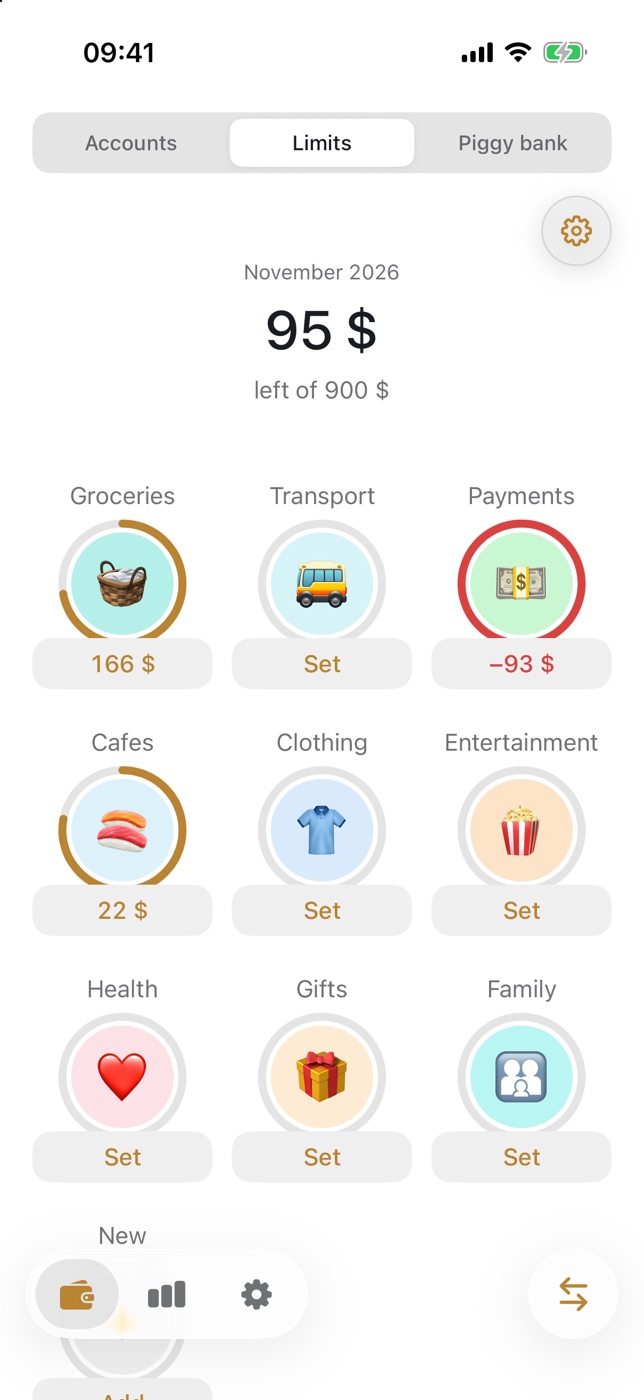
In the app, limits on expense categories play the role of envelopes.
- On the first tab switch from “Accounts” to “Limits”.
- Tap a category, for example “Groceries”, type the envelope amount and tap “SAVE”.
- Tap the gear button to open “Limit settings”: in “Limit period” choose “Month” or “Week”, and in “Starting from” pick your payday.
- Log purchases in their own categories: the ring around the icon fills up, and if you overspend the number turns red with a minus sign.
- Create your savings envelope under “Piggy bank”.
The free version lets you set one limit, so start with your most troublesome category. A limit for every category, meaning a full set of envelopes, comes with the Premium subscription.
FAQ
Do I have to withdraw cash?
No. Cash makes the edge of an envelope tangible, but carrying large sums is not always convenient or safe. What matters is the ban on spending beyond the assigned amount, not the form of the money.
What happens to money left in an envelope at month end?
Decide in advance: roll it into the same envelope next month, send it to savings, or put it towards extra debt repayment. The point is that the leftover gets a job again.
How is this different from the 50/30/20 rule?
50/30/20 sets three broad shares, while envelopes spell out every item. They combine well: shares as the frame, envelopes as the detail.
This article is general education, not individual financial advice.
Sources
- Montana State University: Envelope System
- Soman D., Cheema A. Earmarking and Partitioning: Increasing Saving by Low-Income Households. Journal of Marketing Research, 2011
- Federal Reserve Financial Services: 2025 Findings from the Diary of Consumer Payment Choice
- Federal Reserve Financial Services: 2026 Findings from the Diary of Consumer Payment Choice