 North
The 50/30/20 Budget Rule: How to Split Your Paycheck
The 50/30/20 rule splits take-home pay into three parts: half for needs, 30% for wants and 20% for savings and faster debt repayment. On $3,600 a month that is $1,800, $1,080 and $720. Treat it as a first sketch rather than a law: most people have to bend the proportions to fit their own costs.
Where the rule comes from and what goes where
The formula is associated with the book “All Your Worth” by Elizabeth Warren and Amelia Warren Tyagi, first published in 2005. A North Dakota State University Extension worksheet puts it simply: work out your monthly net income, then divide it into three buckets.
- 50% needs. Housing, utilities, groceries, insurance, required loan payments.
- 30% wants. Eating out, entertainment, the nicer brand of clothes: anything you could live without.
- 20% savings. An emergency reserve and goals; many descriptions of the rule also count extra debt payments here.
According to the same worksheet, whatever you do not spend from the wants bucket simply joins your savings.
Worked example: $3,600 a month
Maya takes home $3,600. She listed last month’s spending and set it against the guideline.
| Bucket | Guideline | Actual | Gap |
|---|---|---|---|
| Needs | $1,800 | $2,124 (59%) | +$324 |
| Wants | $1,080 | $1,188 (33%) | +$108 |
| Savings | $720 | $288 (8%) | −$432 |
This is a common picture: needs took more than half, and the whole shortfall landed on savings. Maya cannot jump to 50/30/20 in one month, because rent does not change overnight. A realistic plan for next month is 57/27/16, or $2,052, $972 and $576. Savings double, and wants shrink by $216, which is achievable.
Why the 50% needs target is hard to hit
Real spending data shows how tight the needs bucket is. In the U.S. Bureau of Labor Statistics Consumer Expenditure Surveys for 2025, housing alone was 33.9% of average annual household spending, transportation 16.5% and food 13.0%. Those are shares of spending, not of income, and part of food and transport is a want rather than a need, but together the three categories come to 63.4% of outlays. Outside the United States the mix differs again, so the honest approach is to start from the split you really have, say 65/20/15, and move it step by step.
The savings bucket matters for a reason that surveys keep confirming. In the OECD/INFE 2023 international survey of adult financial literacy, which covered 39 countries and economies, only 38% of adults reported having money left over at the end of the month. A rule that reserves the savings share first is one way to stop being in the other 62%.
Common mistakes
- Using gross pay. Only what actually reaches your account gets divided.
- Filing wants under needs. Food delivery and a third streaming plan belong to the 30%, however routine they feel.
- Saving “whatever is left”. Moving the 20% on payday is more reliable.
- Quitting after month one. The first month is for learning your numbers, not for hitting them.
How to apply the rule in 1cent
- Log your salary as “Income” and purchases as “Expense” with categories. One month of records gives you real numbers.
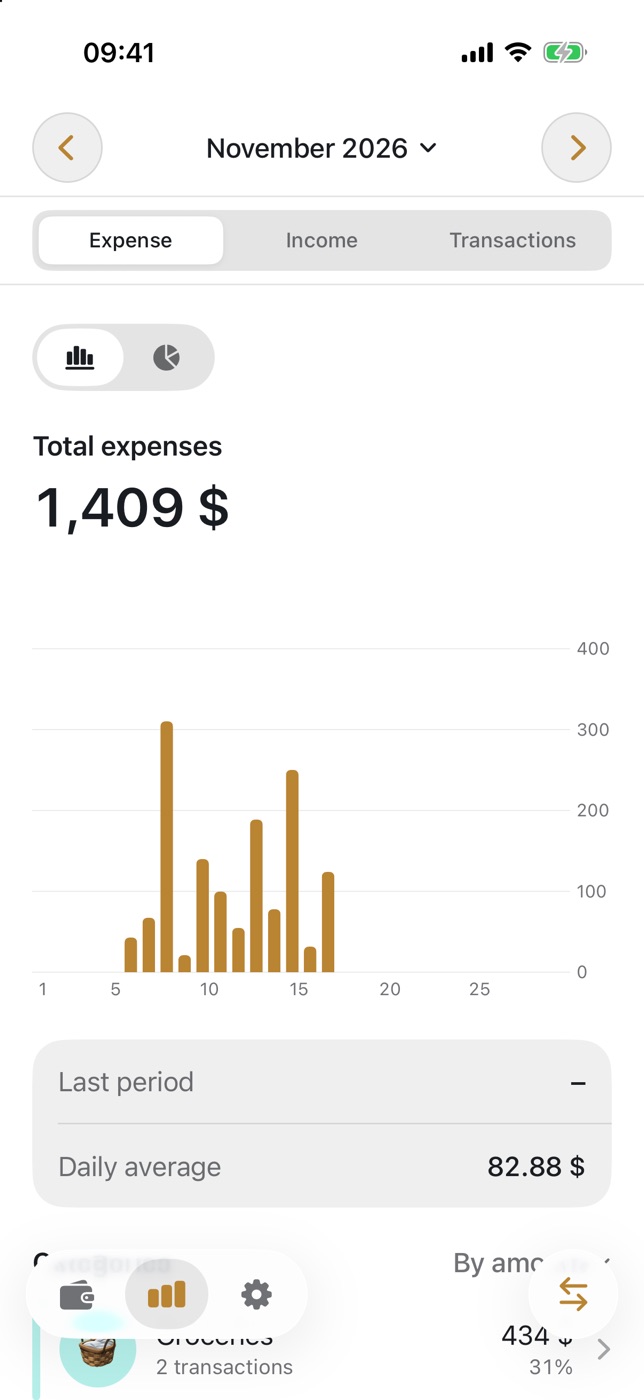
- Open the second tab, Analytics, and look at “Expense”: it shows “Total expenses” and the list of categories with their share. Add the categories up into the three buckets and compare with 50/30/20.
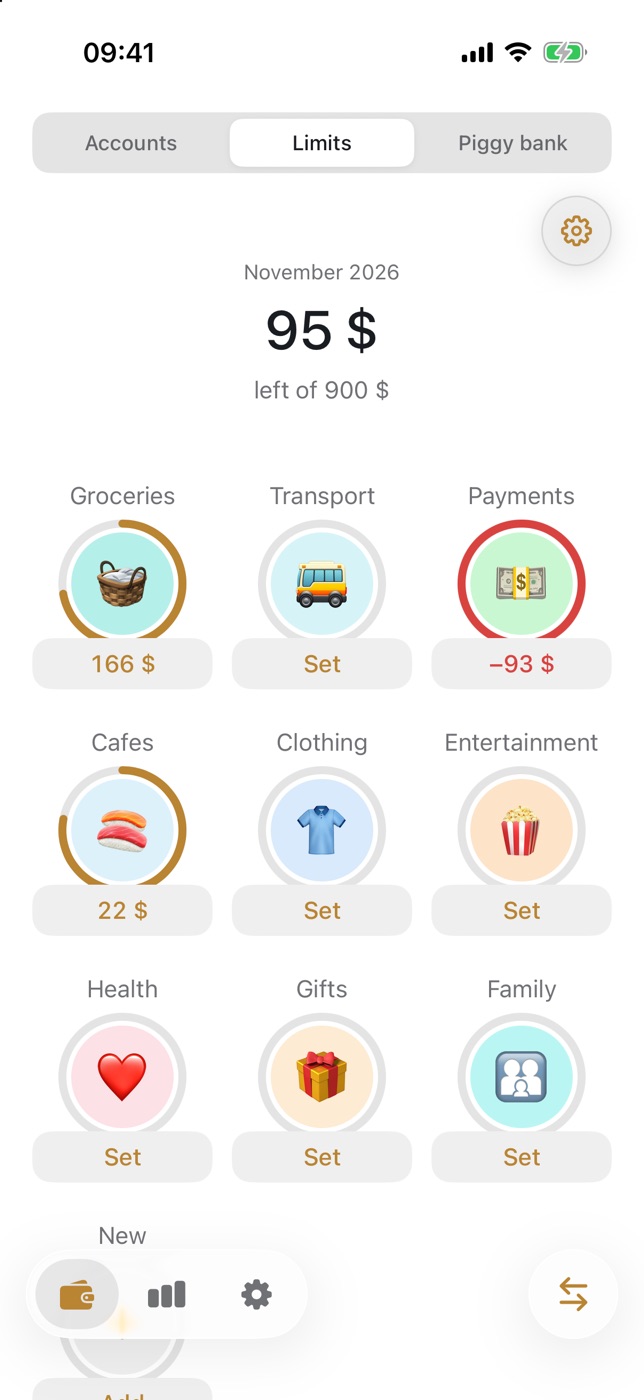
- On the first tab switch to “Limits”, tap the wants category that leaks the most, enter an amount and tap “SAVE”.
- In “Limit settings” (the gear button) set “Starting from” to your payday.
- Move your 20% into a “Piggy bank” on the day income arrives.
The free version includes one limit and one piggy bank, and monthly analytics is free. A limit for every category is part of the Premium subscription.
FAQ
Is a loan payment a need or savings?
The required monthly payment is a need: you cannot skip it. Anything you pay above the schedule is reasonably counted in the 20%.
What if needs take 70% of my income?
Write down the real split and shift it two or three percentage points at a time: review plans and subscriptions first, then the big items. Sometimes the issue is income rather than spending, and the rule shows that plainly.
Do I have to recalculate every month?
A monthly check is enough; recalculate the amounts when your income changes.
This article is general education, not individual financial advice.