 North
Paying Off Debt: Snowball vs Avalanche, Which to Choose
With the snowball method you send all spare money to your smallest debt; with the avalanche method, to the debt with the highest interest rate. In both cases every other debt still gets its required payment. Avalanche usually costs less in interest, while snowball delivers the first closed debt, and a sense of progress, sooner. The better choice is the one you will actually finish.
The shared principle
- List every debt: balance, rate, required payment, due date.
- Work out how much you can pay each month on top of the required payments.
- Send that entire extra amount to one target debt.
- When it is gone, its payment plus the extra rolls on to the next one, which is where the growing snowball image comes from.
The only difference is which debt is the target. The U.S. Consumer Financial Protection Bureau (CFPB) sums up the trade-off: the highest interest rate method can save the most money, though it may not feel like progress for a while; the snowball method shows results quickly, but you may pay more over time.
Worked example: three debts and $500 a month
| Debt | Balance | Rate | Required payment |
|---|---|---|---|
| Store instalment plan | $800 | 12% | $40 |
| Personal loan | $3,000 | 10% | $90 |
| Credit card | $6,000 | 27% | $180 |
Required payments total $310, and the household can add $190. A simplified calculation (interest added monthly, fixed payments, no fees) gives this:
| Snowball | Avalanche | |
|---|---|---|
| Order | instalment → loan → card | card → instalment → loan |
| First debt closed | month 4 | month 21 |
| All debts closed | 25 months | 24 months |
| Total interest | about $2,680 | about $2,070 |
Avalanche saves roughly $610 and a month, but there is no “closed” debt to celebrate for almost two years. The figures are illustrative: in your case the gap could be larger, or close to nothing if the rates are similar.
What the research shows
- People are drawn to small debts anyway. In four experiments by Amar, Ariely and co-authors (Journal of Marketing Research, 2011), participants consistently paid off small debts first even though the larger ones carried higher rates.
- Closed accounts help people finish. Gal and McShane (same journal, 2012) analysed records of nearly 6,000 clients of a debt settlement firm: the share of accounts closed predicted getting rid of the debt better than the share of dollars repaid. This is an observation of a particular group of borrowers, not an experiment.
- Concentration matters. Kettle and co-authors (Journal of Consumer Research, 2016; a field study and three experiments) found that repayments concentrated on one account motivate people more than repayments spread evenly, most of all when it is the smallest account.
The scale of the issue is large. According to the Federal Reserve Bank of New York, U.S. household debt stood at $19.1 trillion in the third quarter of 2026, including $1.29 trillion in credit card balances, and 5.0% of outstanding debt was in some stage of delinquency.
Common mistakes
- Spreading the extra across all debts. That wins neither on interest nor on motivation.
- Skipping a required payment to feed the target debt. A late payment costs more than any saving.
- Not checking early-repayment terms. Rules and possible fees depend on your contract and your country’s law.
- Taking on new credit. The plan only works while the total stops growing.
How to run the plan in 1cent
- On the first tab, under “Accounts”, find the “LOANS” block and tap “+ Add”.
- Fill in “Name”, “Total loan amount”, “Loan balance”, “Monthly payment”, the payment date and the term; “Rate, % per year” is useful for comparing debts.
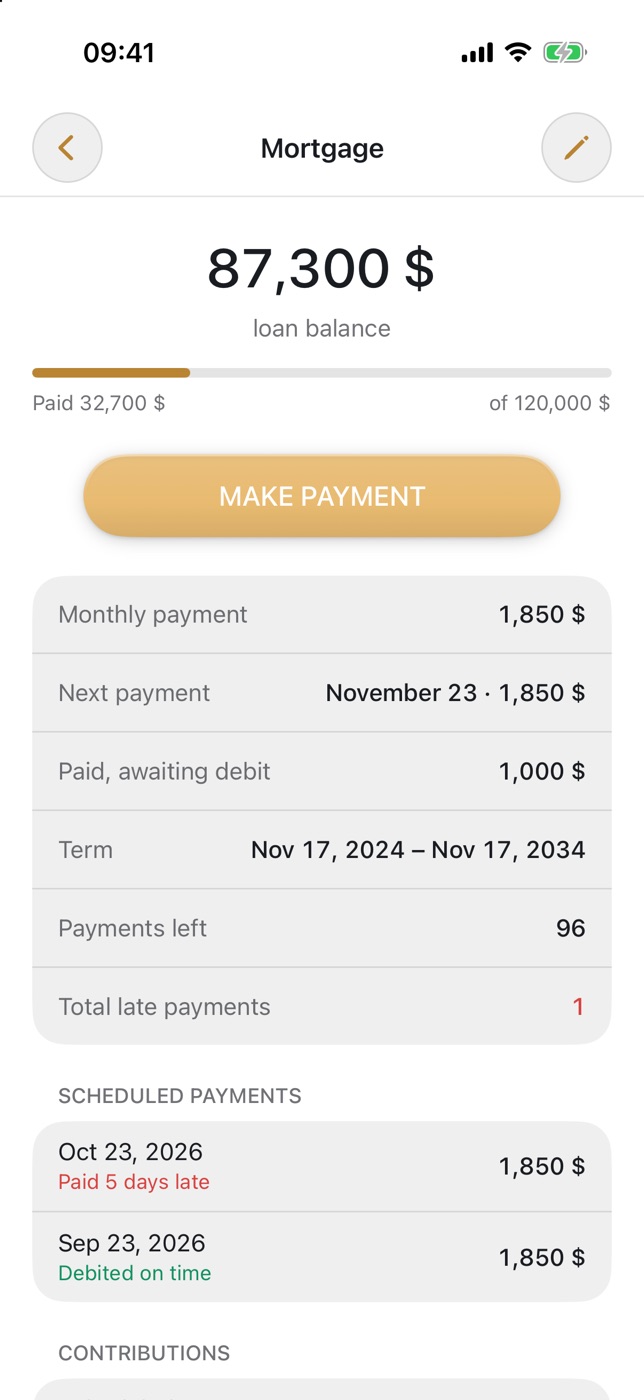
- On payment day open the loan and tap “MAKE PAYMENT”: choose “Payment” for the scheduled instalment and “Partial” for the extra you send to the target debt.
- To take the money from an account at the same time, log the payment as an expense with the “Loan payment” category instead. Use one of the two ways, or the payment is counted twice.
- In Settings → “Reminders” check that “Loan payments” is switched on.
The first loan is free to track; a second one and any further loans require the Premium subscription. The app does not connect to your bank, so compare the balance with your lender’s figure.
FAQ
Can I combine the two methods?
Yes. For instance, clear one or two small debts for a quick win, then switch to the highest rate. When rates are nearly equal, the order barely changes the interest you pay.
What if I cannot cover even the required payments?
Do not wait for a missed payment: contact the lender and ask about restructuring. The options, and any official debt-resolution schemes, depend on your country, so look for them on your financial regulator’s website.
Pay off debt or save?
A small buffer helps keep a surprise bill from becoming a new loan; beyond that it depends on your rates and circumstances.
This article is general education, not individual financial advice.